
Additional Compatibility, Measurements, Auxiliary Structures, and Alinda in House Construction
In Vāstu Shastra, the science of building a house goes far beyond basic measurements and calculations. Once the nine elements (Navapadārtha) and the balance of Āya–Vyaya are considered, several additional factors must also be taken into account to ensure the house becomes a source of prosperity and harmony for its residents.
These include compatibility considerations, the method of measurement, rules regarding dilapidated houses, the design of auxiliary structures, and the role of Alinda — verandas, porches, and extensions that complete the house.
Other Compatibility Factors in Gṛha Melāpaka
When assessing the harmony between a house and its owner (Gṛha Melāpaka), Vāstu texts stress the importance of deeper compatibility factors such as Nāḍī (pulse energy), Gaṇa (temperament), Yoni (instinctual harmony), and Tārā (constellation compatibility).
If the house and the owner share the same Nāḍī, it can lead to long-term illness and chronic health issues. A clash of temperaments, called Gaṇa-vair, results in frequent quarrels and unrest within the family. In cases where the Tārā or nakṣatra is in conflict, the family may face misfortune, including loss of children or wealth. Similarly, a mismatch in Yoni produces constant restlessness and lack of peace in the household.
Varṇa, or social category, is also mentioned as a factor influencing prosperity. If the house and its owner are not aligned in Varṇa, the natural flow of wealth and growth is obstructed.
Furthermore, the weekday on which the foundation of the house is laid plays a role in determining its fortune. Auspicious weekdays ensure prosperity, while inauspicious ones — particularly those ruled by planets like Saturn — may bring quarrels, poverty, or danger.
नाड़ी दोष चक्र
| नाड़ी | नक्षत्र (नाम के प्रथम अक्षर का नक्षत्र) |
|---|---|
| आदि नाड़ी | अश्विनी, आर्द्रा, पुनर्वसु, उत्तराफाल्गुनी, हस्त, श्रवण, शतभिषा, पूर्वाभाद्रपद |
| मध्य नाड़ी | भरणी, मृगशिरा, पुष्य, उत्तरााषाढा, धनिष्ठा |
| अन्त्य नाड़ी | कृतिका, रोहिणी, आश्लेषा, मघा, चित्रा, स्वाती, ज्येष्ठा, मूल, पूर्वाषाढा, उत्तराभाद्रपद, रेवती |
गणबोधक चक्र
| गण | १. देवगण | २. मनुष्यगण | ३. राक्षसगण |
|---|---|---|---|
| गणों के नक्षत्र | अश्विनी, मृगशिरा, पुनर्वसु, पुष्य, अनुराधा, हस्त, श्रवण, स्वाति, रेवती | भरणी, आद्रा, रोहिणी, उ०फा०, उ०षा०, उ० भा०, पू०फा०, पू०पा०, पू० भा० | कृत्तिका, श्लेषा, मघा, ज्येष्ठा, चित्रा, विशाखा, मूल, शतभिषा, धनिष्ठा |
| मित्रगण | देवता | मनुष्य | राक्षस |
| समगण | मनुष्य | देवता | x |
| शत्रुगण | राक्षस | राक्षस | देवता, मनुष्य |
योनि मेलापकबोधक चक्र
| क्रमांक | योनि | नक्षत्र | वैर योनि |
|---|---|---|---|
| १ | अश्व | अश्विनी, शतभिषा | महिष |
| २ | महिष | हस्त, स्वाती | अश्व |
| ३ | सिंह | धनि , पू.भा. | गज |
| ४ | गज | भरणी, रेवती | सिंह |
| ५ | मेष | कृतिका, पुष्य | वानर |
| ६ | वानर | श्रवण, पू.षा. | मेष |
| ७ | नकुल | उ.षा., अभि. | सर्प |
| ८ | सर्प | रोहिणी, मृग | नकुल |
| ९ | हरिण (मृग) | अनु., ज्ये. | श्वान |
| १० | श्वान | आर्द्रा, मूल | हरिण |
| ११ | मार्जार | पुनर्वसु , श्लेषा | मूषक |
| १२ | मूषक | मघा, पू.फा. | मार्जार |
| १३ | व्याघ्र | विशा., चित्रा | गो |
| १४ | गो | उ.भा., उ. फा. | व्याघ्र |
वर्णबोधक चक्र
| क्रमांक | राशियाँ | नक्षत्र | राशि एवं नक्षत्र का वर्ण |
|---|---|---|---|
| १ | मेष | अश्विनी, भरणी, कृत्तिका | क्षत्रिय |
| २ | वृष | रोहिणी, मृग. | वैश्य |
| ३ | मिथुन | आर्द्रा, पुनर्वसु | शूद्र |
| ४ | कर्क | पुष्य, श्लेषा | विप्र |
| ५ | सिंह | मघा, पू. फा., उ. फा. | क्षत्रिय |
| ६ | कन्या | हस्त, चित्रा | वैश्य |
| ७ | तुला | स्वाति, विशाखा | शूद्र |
| ८ | वृश्चिक | अनु., ज्येष्ठा | विप्र |
| ९ | धनु | मूल, पूर्वाषाढ़ा, उ. षा. | क्षत्रिय |
| १० | मकर | श्रवण, धनि | वैश्य |
| ११ | कुम्भ | शत., पू.भा. | शूद्र |
| १२ | मीन | उ. भा., रेवती | विप्र |
Measuring the House with the Owner’s Hand
One of the unique principles of Vāstu is that the dimensions of the house should be measured with the hasta (hand span) of the owner. The harmony between the human body and the house is emphasized here, as the dwelling is meant to be an extension of the self.
If the length and breadth of the house, measured in the owner’s hasta, result in odd numbers, the dwelling is considered auspicious. Even-numbered results are inauspicious, though this can be corrected by making slight adjustments in aṅgulas (finger units). These corrections bring the structure into favorable alignment.
It is also specified that this rule applies only when the length of the house is between 11 and 32 hastas. For houses larger than 32 hastas, the focus shifts to broader calculations such as Āya–Vyaya and the Navapadārtha, since the smaller-scale harmonics no longer apply.
On Old and Dilapidated Houses
Vāstu texts make it clear that calculations of Āya–Vyaya and Māsa-śuddhi (monthly auspiciousness checks) are relevant only for newly constructed houses. For old or dilapidated houses (jīrṇa gṛha), these calculations are unnecessary.
Such dwellings, having reached the end of their lifespan, cannot be revitalized through astrological adjustments and should instead be abandoned or reconstructed. This principle shows the practical wisdom of Vāstu, which does not encourage clinging to worn-out structures.
Sixteen Auxiliary Structures
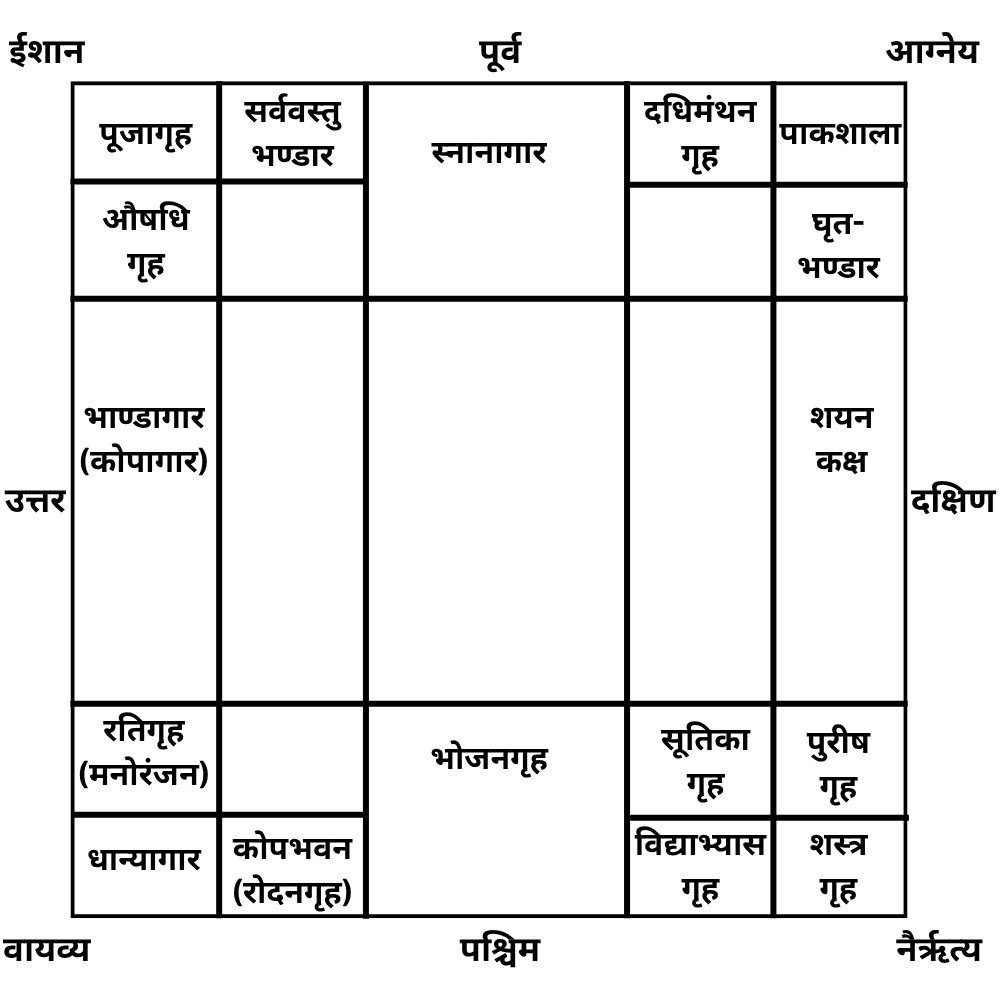
Vāstu Shastra prescribes sixteen auxiliary structures (upakaraṇa gṛhas) that support the main residence. Each has a fixed place in the house to maintain harmony and balance. The pooja room is placed in the northeast, along with the treasury, while the kitchen is located in the southeast. Bedrooms for young couples are also suited for this corner, whereas the southern side is used for the daughters’ quarters.
The southwest is assigned to women’s rooms and the maternity chamber (Sūtikāgṛha), along with the grain storage. The northwest holds the bathing rooms and spaces for entertainment, while the west is set aside for the study room. The east is suitable for the dining hall and reception. The north contains medicines and remedies, and the center, or Brahmasthāna, is kept open as a courtyard for air, light, and auspicious energy.
These sixteen structures together form the complete framework of a house, ensuring that worship, health, wealth, learning, family life, and social duties all find their proper place within the dwelling.
—
The Sūtikāgṛha (Maternity Room)
The Sūtikāgṛha is the specially designated maternity room in a house. Traditional texts recommend constructing it in the southwest corner (Nairṛtya), especially for rulers or prosperous households desiring wealth and prosperity.
The room should be fully prepared in advance so that when a woman is near childbirth, she may immediately be admitted into it. Keeping it ready beforehand is considered most auspicious. Entry into the Sūtikāgṛha should be done on a favourable day during the bright fortnight (Śukla Pakṣa), preferably in the ninth month of pregnancy.
Thus, the Sūtikāgṛha is not merely a functional space but one that is ritually and astrologically significant, ensuring the health of the mother, the safe delivery of the child, and the prosperity of the family.
The Significance of Alinda
Another important element in house design is the Alinda — verandas, porticos, porches, balconies, and covered extensions that are attached to the house. Alindas are both functional and symbolic. They shield doors and windows from sun and rain, facilitate the flow of air and light, and create transitional spaces between the inner and outer world.
Vāstu classifies houses into sixteen types based on the form of Alinda, each carrying specific results. Some, like Dhruva Alinda and Dhana Alinda, bring stability and wealth, while Jaya Alinda grants victory and fame. Others such as Śubha, Saukhya, Mṛdu, and Puṣṭi Alinda bring happiness, peace, and nourishment.
Equally significant are the inauspicious varieties — Khara Alinda and Durmukha Alinda — which bring poverty, disputes, and misfortune. Thus, the form and placement of Alinda are decisive factors in shaping the destiny of the household.
Sixteen Types of Houses Based on Alindas
By the arrangement of doors and Alindas in different directions, houses are classified into sixteen types. Each type has a distinct name and brings specific results:
- Dhruva – Grants stability, wealth, grain, and happiness.
- Dhanya – Brings abundance of food and prosperity.
- Jaya – Bestows victory and success.
- Nanda – Brings prosperity through women and grain.
- Khara – Causes loss of movable and immovable property.
- Kānta – Ensures progeny, sons, and grandsons.
- Manorama – Brings the grace of Śrī (Lakṣmī) and overall auspiciousness.
- Sumukha (Suvaktṛa) – Grants pleasures and enjoyment.
- Durmukha – Leads to unpopularity and social rejection.
- Ugraya (Krūra) – Causes cruelty and sorrow.
- Ripuda – Invites enmity and troubles from enemies.
- Dhanada – Ensures abundance of wealth.
- Kṣaya – Brings decay, losses of wealth, people, and cattle.
- Ākranda – Causes constant quarrels and disputes.
- Vipula – Brings great prosperity, reputation, and wealth.
- Vijaya – Bestows victory and accumulation of wealth.
The type of house is determined by adding the numerical values assigned to the directions of doors and Alindas, then deriving the result according to prescribed sequences. For example, if Alindas are placed in the east, south, and west, the corresponding values are added. The sum, when matched to the sequence, indicates the resulting house type and its effects.
The wisdom of Vāstu extends beyond structural proportions and astrological charts. It integrates the subtle dimensions of compatibility, personal measurement, auxiliary structures, and the symbolic role of Alinda to create a holistic dwelling.
By aligning the house with the pulse of its owner, ensuring harmony in relationships through compatibility checks, designing auxiliary structures for every aspect of life, and selecting the right form of Alinda, one ensures that the house becomes more than a shelter. It becomes a living organism, harmonized with cosmic order, supporting health, prosperity, and happiness across generations.