
Vāstu Guidelines for Auspicious Excavation
Beginning excavation — the first strike into the earth — is treated in classical Vāstu as a decisive, almost liturgical act. The ancient authorities instruct us to choose the right stars (nakṣatras), the right weekday, and the right omens; they warn about the shadowy influence of Rāhu and give detailed tests and rituals to ensure a successful start. This process is closely related to Rahu's position in foundation digging and construction timing principles.
Below is a practical, faithful rendering of those instructions in plain language, preserving the full set of checks and signs recorded in the text.
Choose the right rāśi / nakṣatra and weekday
The text recommends beginning digging during the so-called adhomukha (downward-facing) nakṣatras — those considered favorable for activities that go down into the earth, like wells, ponds, pits and foundation trenches. The names given include Mūla, Āśleṣā, Maghā, Pūrva Phālgunī, Pūrva Āṣāḍhā, Pūrva Bhādrapadā, Viśākhā, Bharaṇī and Kṛttikā.
Equally important is the weekday: the scriptures single out Monday, Wednesday, Thursday and Friday as the appropriate days for starting excavation — provided the householder (the karta) enjoys sufficient chandra-bala (lunar strength) and tara-bala (support from the nakṣatra). When those conditions align, digging for wells, reservoirs, mines and foundations is auspicious and likely to succeed.
Why Rāhu’s position matters (three-month cycles)
Rāhu — the shadow-planet represented as a serpent-body in Vāstu lore — is said to “lie” across a plot in a changing pattern. The classical rule is that Rāhu occupies each main direction in cycles of three solar months: in one three-month span he favors the east, in the next the south, then the west, then the north. Practically this means you should never begin digging where Rāhu’s body or an important part of it lies at that moment.
दिग् राहु चक्र
| दिग्राहु की दिशा | पूर्व दिशा में | दक्षिण में | पश्चिम में | उत्तर में |
|---|---|---|---|---|
| सूर्यराशि में | वृश्चिक-धनु-मकर | कुम्भ-मीन-मेष | वृष-मिथुन-कर्क | सिंह-कन्या-तुला |
| स्तंभ निवेश का फल | वंश-विनाश | वंश-विनाश | वंश-विनाश | वंश-विनाश |
| द्वार निवेश का फल | अग्निभय | अग्निभय | अग्निभय | अग्निभय |
| यात्रा का फल | कार्यहानि | कार्यहानि | कार्यहानि | कार्यहानि |
| गृहारम्भ फल | कुलक्षय | कुलक्षय | कुलक्षय | कुलक्षय |
The consequence of ignoring this rule is repeatedly emphasized: if you begin a pillar (stambha) in Rāhu’s occupied direction you invite lineage loss; making a doorway there invites fire danger; traveling in that direction or carrying out tasks there brings loss of work; and starting a house in Rāhu’s occupied direction can wreck the family line.
For this reason the month-to-month position of Rāhu (checked via an almanac or jyotiṣa) is treated as essential construction intelligence.
Rāhu and weekdays — practical warning
The source also enumerates how Rāhu’s position shifts with the weekday, and it cautions against moving into or beginning major work in the direction Rāhu occupies on that day.
The old line gives a weekday sequence (starting from Sunday) which associates each day with a particular direction for Rāhu; practitioners therefore consult the almanac and avoid the direction Rāhu occupies on the intended weekday.
In short: if the calendar places Rāhu in a direction on a particular weekday, do not begin digging or place a primary opening (door, pillar) into that direction that day.
Body-parts of Rāhu and where to dig
Classical Vāstu describes Rāhu as if his serpent-body extends across the site; digging into different “parts” of that body produces different effects. The text is explicit: excavation at Rāhu’s head brings destruction to the person who digs; digging at his back invites harm to parents; striking his tail causes the loss of wife and children.
By contrast, digging at Rāhu’s kukṣi (the belly or empty womb area) is auspicious: it brings wealth, grain, sons and general prosperity. Because the kukṣi shifts position with the sun through groups of three solar months, the practical instruction is to locate Rāhu’s kukṣi for the current period and start excavation there rather than at any part that would strike head, back or tail.
Nakṣatra placement across the four directions and the Moon’s effect
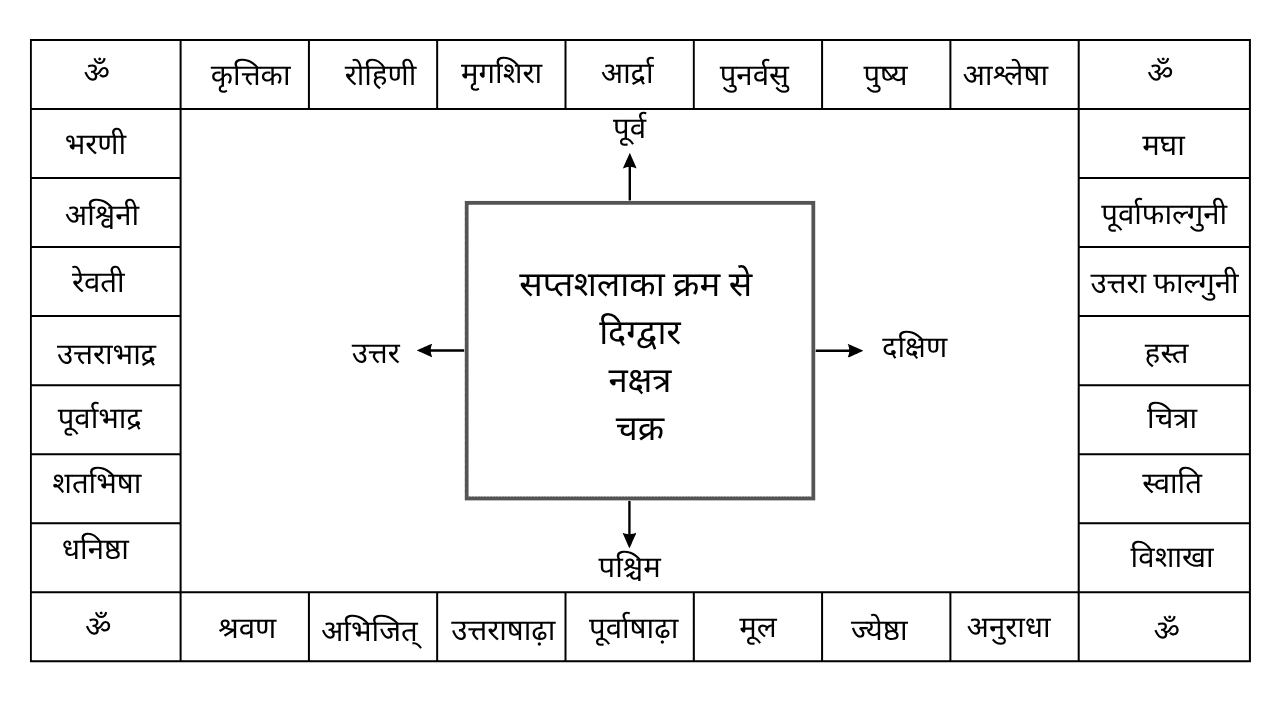
The treatise also distributes the nakṣatras into directional groups and emphasizes the Moon’s location among them.
It indicates which sets of nakṣatras belong to east, south, west and north respectively, and explains that the Moon’s placement in these groups at the time of digging affects likely outcomes:
Moon in the eastern set can cause fear to the owner;
- in the western set it can harm the worker;
- in the southern set it tends to increase wealth;
- and in the northern set it brings family happiness and prosperity.
Thus a careful practitioner checks not only the nakṣatra suitability for digging but where the Moon sits relative to the directional groups.
Choosing nakṣatras with the house’s entrance in mind
Beyond the digging itself, the text advises selecting nakṣatras for house-starting (gṛhārambha) in relation to the planned main entrance.
For an east- or west-facing main door, certain nakṣatras are preferred (the source lists Uttarā Phālgunī, Hasta, Citrā, Svāti, Dhaniṣṭhā, Śatabhiṣā, Uttarā Bhādrapadā and Revatī among the auspicious ones); for a north- or south-facing door other nakṣatras such as Rohiṇī, Mṛgaśīrṣa, Puṣya, Uttarāṣāḍhā and Anurādhā are indicated.
The practical rule is to avoid those stars which would be ill-placed relative to the intended door direction.
The ritual: worship, the first strike and its meaning
Before any pick touches the earth, the instrument (iron rod, crowbar or spade) must be worshipped together with Bhairava, the guardians of the directions and Mother Earth. The first strike is then delivered with full strength. The implement is left in the ground and covered; an invited learned person measures how many finger-widths the tool has sunk.
The text gives a clear divinatory rule: if the iron instrument has sunk by an odd number of finger units (three, five, seven, nine, etc.), it is interpreted as an indication of male offspring and prosperity; if it has sunk by an even number, it points to female offspring; if the measurement falls into an ambiguous, middle or otherwise irregular count (the original text cites intermediary and anomalous measures), it is taken as inauspicious and warns against beginning the work without remedial rites.
Auspicious signs at excavation time
The moment of digging is read like an oracle. Hearing Vedic recitation, auspicious songs, or the sounds of flute, veena or mṛdaṅga is highly favorable. Seeing pure substances and ritual items — curd (dādhi), sacred grass (dūrva), kuśa, uncooked rice (akṣata), vermilion (kuṅkum), flowers, fruits, gold, silver, copper, conch, pearls, coral and gemstones — are taken as strong positive tokens that the land will be prosperous for dwelling. Finding well-formed bricks or attractive stones or pleasant soil is likewise a good sign.
Inauspicious signs to avoid
Conversely, certain finds or sights at the pit predict trouble. Discovery of thorns, scorpions, dangerous seeds like small thorny palms, venomous animals (snakes, scorpions), bones, charred wood, broken iron tools, coal, ashes, foul odors, muddy sludge, blood or even swarms of destructive insects are all read as negative omens.
The classical author also lists specific problematic items — jagged iron tools, deep cracks, heavy rock seams, buried animal or human remains — and advises abandonment of the site or performance of remedial rites should they appear.
Ants and white ants (termites) are singled out as particularly inauspicious because they indicate decay; their presence is taken as a sign that building there will bring harm unless ritual purification is performed.
Practical wrap-up
In short, excavation is governed by a layered checklist: favorable nakṣatras (adhomukha stars), auspicious weekdays (especially Monday, Wednesday, Thursday and Friday when lunar and star strength support the act), the avoidance of Rāhu’s occupied parts (never strike the head/back/tail), measurement divination after the first strike (odd → sons/prosperity; even → daughters; ambiguous → caution), and the reading of audible and visible omens which either bless the project or warn against it.
Classical Vāstu repeatedly stresses checking the almanac (for Rāhu's placement and the current nakṣatra) and engaging the traditional rites: worship of the instrument and deities, recitation of sacred verses, offering of grains and flowers, and performance of purification with the five cow-products and the five nectars when required. Doing so aligns the builder's action with cosmic forces and greatly improves the chances that the foundation will lead to a stable, prosperous household. For complete guidance, explore vastu rituals for auspicious beginnings and sacred land testing practices.